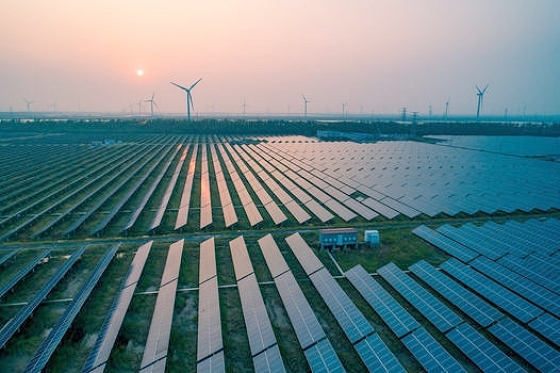
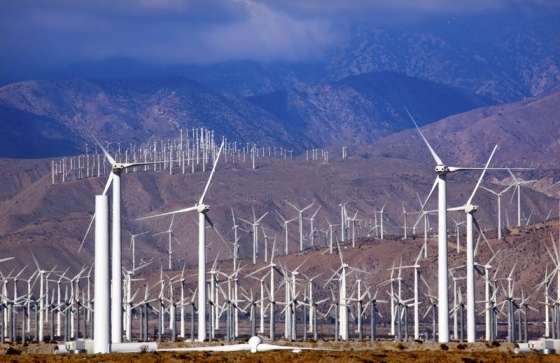
no thanks <-- back to 12/31/2024 Roger Luebeck This little analysis is just a reality check for the plausibility of arresting global warming with renewables without a massive reduction in energy consumption -- just the latest of my many energy analyses. -------------------------------------------------------- China's new solar energy project in the Kubuqi Desert occupies an area 250 miles long by 3 miles wide, and has an ultimate nameplate capacity of 100 GW. Tom Howarth, science reporter for Nature, writes about it on December 31 2024: "China's rapid expansion of solar power is a significant step in addressing global climate challenges." -------------------------------------------------------- How significant? The power capacity of that colossal project, not to be completed until 2030, translates to 0.0012 of the world's total current power consumption. With their mineral wealth and efficient manufacturing systems, China is better positioned for solar-array production than any other country. Yet, this single project will take China five years to complete. And another 780 projects of this scope would be needed to complete the switch to all-renewable energy for Earth. -------------------------------------------------------- The math: Kubuqi Desert project nameplate capacity = 100 GW With energy lost between generation and consumption, the final capacity factor for solar, globally, is less than 0.25. The initial capacity factor is the ratio of generation/nameplate, which can be as high as 0.35. Generously assuming a final capacity factor of 0.25 -- 0.25 x 100 GW = 25 GW --> 219 TWh yearly energy consumption = 0.0012 global total yearly energy consumption (global E) = 1/835 of global E of 183,000 TWh (as of 2024) : After allowing for the world's currently installed renewables yielding 12,000 TWh yearly consumption (generous estimate based on 3870 GW installed capacity) -- 780 additional such colossal Kubuqi Desert projects are required to match the world's global energy usage. : : There is only 60 GW of nuclear power under construction. The IEA projects an additional 4800 GW renewables nameplate installation between 2025 and 2030 (inclusive?). Using an optimistic final capacity factor of 0.3, that would put us on track for renewables accounting for about 1/9 of global energy consumption as of 2030. If we could somehow increase the yearly nameplate installation between 2030 and 2050 to 2000 GW -- (2.5 X the projected rate of the 2025 - 2030 period, which is higher than anyone has been able to imagine) -- we'd have another 40,000 GW nameplate added between 2030 and 2050. That would get us to about 130,000 TWh consumption of renewable energy in 2050. As of this writing, global energy consumption continues to increase by 2 percent every year. If global E consumption were to level off at 200,000 TWh (not going to happen), then renewables could -- by great stretch of the imagination -- account for 2/3 of global E consumption by 2050. That would mean we're still adding an enormous amount of CO2 every year. On top of that -- long before 2050 arrives, we will need to begin replacing all the wind and solar we've already installed, leaving us unable to produce new installations. : : With current technologies and global political order, it is not realistic to imagine we can use the Sahara or various Asian deserts for massive solar farms from which to export energy to the rest of the world. Beyond the daunting and resource-intensive problem of transferring the energy across the ocean is the question of who would control the source and the transmission. If we try to provide renewable energy for ourselves from within our own continent as our sole energy while maintaining our current level of energy consumption, it would be to the extreme detriment of the landscape and ecology.My wind/solar image based on my analysis of 5/13/21:
Princeton wind/solar image from 10/29/21:
With nuclear, you get this:
With renewable, you get this:
no thanks <-- back to