The EPA is the center of the universe for pretend engineers, incompetence and DEI. It is a self-perpetuating, self-bloating, cesspool of idiocy.
The entire lead paint containment program at the EPA, which generates hundreds of millions of dollars annually of wasted time and a commensurate amount of pollution, could be replaced by a simple placard sitting on the counter of paint retailers, containing just a few common sense guidelines, enforced locally by city or county agents, at one millionth the cost.
Here are a few examples of EPA lead-containment rules:
1. EPA fantasy world:
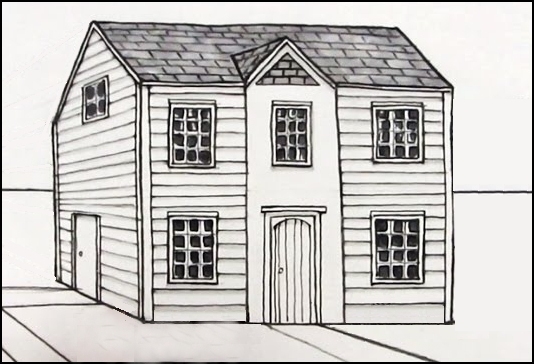
An EPA-generated model of a house, utilized for describing how to contain paint chips at a jobsite:
Photographs of actual typical houses in need of surface-preparation:
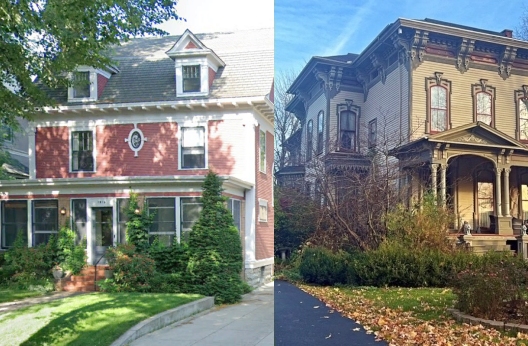
As you can plainly see, the people at the EPA have
never actually seen a real house with a real yard.
2. Regarding interior work, we were told by the EPA in our required class to cover the floor with plastic sheeting extending six feet outward from any interior window unit on which we want to perform surface-prep, then hermetically seal the edges of the plastic sheet to the floor using duct tape.
They required that we fold up the plastic sheeting after prep work was complete, then thoroughly clean the portion of the floor that the plastic sheeting had covered. In fact, we were required to vacuum that portion of the floor using a vacuum with a HEPA filter, then damp mop that same portion of the floor, followed by a wipe with a special cloth which was developed to test surfaces for cleanliness. All those procedures were to be performed on the area of the floor that had been hermetically sealed with plastic sheeting and duct tape.
As for the area of the floor outside the portion covered by the plastic sheeting: we were told that any dust or chips in such area was not our responsibility. If there is lead dust an inch thick, it doesn't matter -- because it is outside the area of the specified six-foot rule.
3. The EPA made it illegal to pressure-wash a house that has any lead-containing paint on it, even if such paint is completely encapsulated by more recent coatings that are sound and continuous and contain no lead. The "engineers" at the EPA seem to think that pressure-washing could actually penetrate the upper layers of paint and somehow dislodge lead in a deeper layer. Anyone who has actually pressure-washed a house will tell you that that is not remotely possible. The most obvious evidence of that is that the color of the existing paint does not change as a result of pressure-washing -- meaning that the paint is .. still there, forming the barrier.
Even exposed leaded paint will not release lead when subjected to pressure-washing. It would take sanding or scraping to release lead.
Even in situations where pressure-washing can dislodge precariously attached lead paint chips, it does not create dust. Thus, the simple use of tarps -- with a few perforations to let water pass -- would contain the paint chips without sending particles into the environment.
Result: Inferior washing is typically performed, and dirty surfaces get painted -- resulting in premature paint failure and pollution associated with that failure.
The EPA does allow pressure-washing in such a situation if one incorporates the following preposterous methodology:
The contractor is to somehow attach plastic sheeting to the base of the entire house using duct-tape, then construct an elaborate system of water-channeling using wood framing members to which more plastic sheeting is somehow attached. This elaborate -- and wildly impossible -- aqueduct is to purportedly channel all the water generated by pressure-washing to a giant expensive gas-guzzling machine sitting on the street which filters the water.
Not only can one not remotely hope to attach plastic sheeting to a house in a seamless manner using duct tape and expect it to not pass water -- one can't hope to make such a seamless system to begin with. See the real-life photographs above.
If one could actually pull off such a stunt, it would generate pollution that is many orders of magnitude more harmful -- just with the plastic used -- beyond that resulting from unfettered pressure-washing to begin with. And, as mentioned further down, the price tag would simply compel a homeowner to simply abandon having necessary work done on his house.
4. The contractor is required to wear paper or plastic booties while working inside his containment area on the outside of a house. Every time he steps off his containment tarps -- such as for the purpose of going to his supplies area for a tool -- he must remove his booties.. and put them on again.
This despite that, in reality, things simply don't cling to the bottom of one's shoes in any substantive manner in such settings. Any micro-substance that might be shed by the worker's shoes isn't 1/1000000 the amount of what is simply shed by such a house (in need of attention) over the course of a year.
And of course, any person who has actually worked on old houses will tell you that there are days when one is constantly going to his truck or his supplies area for tools or materials. One can't have everything in their work space at all times. And it's not close.
5. The EPA forbids dry hand-sanding on exterior wood even after the wood has been completely stripped of paint. They claim that such hand-sanding will dislodge a micro amount of lead still in the wood and distribute it into the environment at great peril. It will not. (See paragraph two of number four above.)
And so, they require that the contractor wet the wood with a spray bottle immediately prior to hand-sanding. Ever wet-sanded wood? See the final sentence of number four above.
6. The EPA requires the use of a HEPA vacuum to clean up any stray chips that land beyond the containment tarps. A regular vacuum doesn't suffice for them.
And then.. they tell you that any lead paint debris that collects at the base of the house (meaning lead paint chips that got past the inner edge of the containment tarp) must not be vacuumed or touched (apparently not even with latex-gloved hands). Rather, they instruct us to push dirt over the top of the lead paint chips -- leaving the lead paint chips permanently in the ground under an inch or two of dirt.
Throughout the nonsense, it's clear that these people think that lead is in the same category as anthrax. But with only half their minds. The other half of their minds has it in the category of a benign substance.
7. At our EPA-required full-day class (at a cost of $450, plus a day's wages lost -- every five years), we were required to crawl around on our hands and knees taping plastic sheets to the base of a large cardboard box which sat on the linoleum floor.
In the minds of these people who are isolated from the real world, this demonstrates the competence of a contractor to contain lead paint chips at an exterior job site.
At each of the three classes I've thus far attended, both the instructor and the entire class engaged in frequent bouts of laughter or groaning at the nonsense that the instructor is obliged to present. The instructors don't keep it a secret that they are there both for the money and to provide emotional support to the contractors who have to put up with the nonsense.
8. A contractor can be fined $37,500 per day for any violation of the EPA rules, of which there are hundreds existing on the hundreds of pages of online documents that are ever-changing -- and which no-one could possibly ever hope to read anyway. And why would anyone want to read such insanity.
The nonsensical rules perpetrated by the EPA greatly increase the prices quoted by painting contractors, causing home-owners to forego having the necessary work performed on their houses. That leads to more lead paint chips being shed from their houses into the environment, and to rotting wood; in other words -- yet more pollution courtesy of the EPA.